The Death of Academic Integrity and Human Grading Standards
Daftar Isi
- The Mirage of Personalized Prestige
- The Silent Rise of the Human Grading Standard Alternative
- The Industrial Kitchen Analogy: Why Quality is Spilled
- The Scalability Trap in Modern Pedagogy
- When the Algorithm Becomes the Professor
- The Long-Term Consequences for the Workforce
- Reclaiming the Soul of Higher Education
We all agree that an elite university degree is supposed to be the ultimate seal of quality. You pay for the proximity to brilliance, the late-night debates in gothic libraries, and most importantly, the meticulous scrutiny of your ideas by world-class scholars. However, there is a quiet revolution happening behind the ivy-covered walls that should keep every student and parent awake at night. I promise to show you how the traditional human grading standard is being dismantled and replaced by something far more sterile. In this article, we will explore why elite institutions are trading their pedagogical souls for the convenience of automation and what this means for the future of intellectual rigor.
Think about it.
For centuries, the hallmark of a Harvard or Oxford education wasn't just the curriculum; it was the "red pen." It was the professor spending hours deconstructing a student's thesis, challenging their logic, and forcing them to think beyond the obvious. But today, that red pen is running out of ink, or rather, it is being replaced by a digital cursor that lacks a heartbeat.
The Mirage of Personalized Prestige
Elite universities sell a dream of personalized mentorship. They market low student-to-faculty ratios and intimate seminar rooms. But if you look under the hood of the modern administrative machine, you will see a different reality. The sheer volume of content produced in the digital age has overwhelmed the traditional academic structure. As enrollment grows and administrative overhead bloat continues, the actual time a professor spends looking at a student's work has plummeted.
It is like buying a hand-tailored suit only to find out it was stitched by a robot in a dark factory. The label says "Bespoke," but the seams tell a different story. This is the first step toward the death of academic integrity: the commodification of the feedback loop. When feedback becomes a luxury rather than a standard, the very foundation of higher education begins to crumble.
The Silent Rise of the Human Grading Standard Alternative
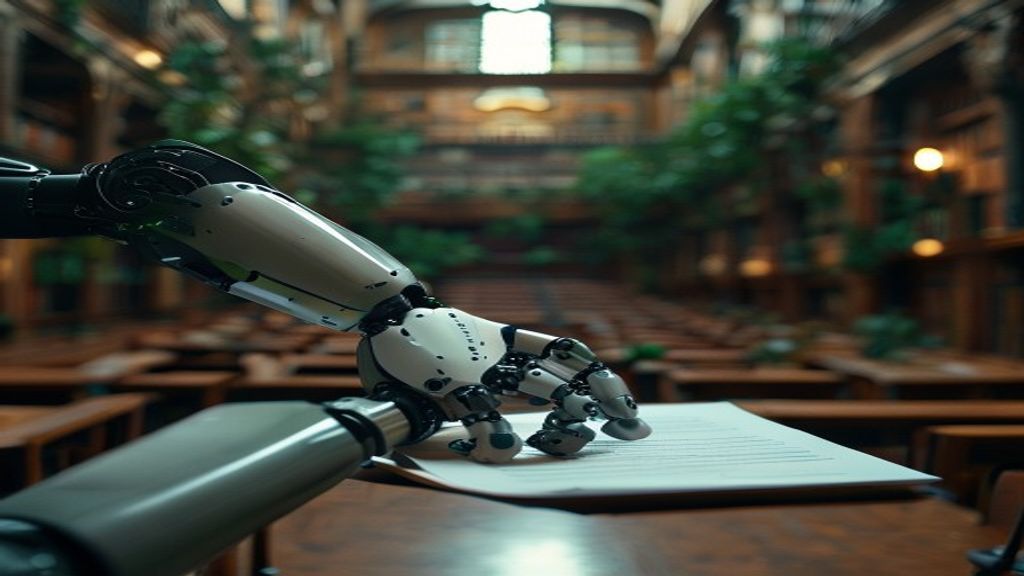
Why are universities moving away from the human grading standard? The answer is as simple as it is cynical: efficiency. We are seeing a massive shift toward grading automation and the use of generative AI in academia to handle the heavy lifting of assessment. While the marketing brochures still talk about "academic excellence," the back-end systems are increasingly looking for ways to remove the human element from the evaluation process.
But here is the kicker.
The transition isn't being announced with a press release. It is happening through "pilot programs" and "AI-assisted feedback" tools. These tools are marketed as aids for busy professors, but in reality, they act as a buffer between the teacher and the taught. When a machine grades an essay, it isn't looking for a "spark of genius" or a "risky but brilliant argument." It is looking for patterns, keywords, and structural compliance. It rewards conformity over creativity.
This shift creates a ripple effect of Ivy League grade inflation. Because machines are programmed to be "fair" and "consistent" based on rubrics, they often fail to penalize the lack of depth that a human expert would spot instantly. The result? Everyone gets an 'A', but nobody actually learns how to think.
The Industrial Kitchen Analogy: Why Quality is Spilled
To understand what is happening, imagine an elite restaurant. You go there for the chef’s unique palate and years of experience. Now, imagine that same chef starts using pre-packaged, frozen ingredients and sets an automated oven to cook everything. The food might look the same, and it might even taste "fine," but the artistry is gone. The chef is no longer tasting the sauce; they are just checking the timer.
In this analogy, pedagogical integrity is the taste of the sauce. When elite universities abandon the human touch, they are turning their classrooms into industrial kitchens. They are serving high-priced "intellectual calories" that offer no real nutritional value for the mind. The digital academic surveillance tools used to track student progress are more interested in "completion rates" than "comprehension depth."
The Scalability Trap in Modern Pedagogy
The push for scalability in higher education is perhaps the biggest enemy of integrity. Universities are businesses, and businesses love scale. However, true education is notoriously unscalable. You cannot "mass produce" a deep understanding of Kantian ethics or quantum mechanics. It requires time, friction, and the messy interaction of two human minds.
By adopting AI-assisted feedback, institutions are trying to have their cake and eat it too. They want the revenue of thousands of students without the cost of hiring thousands of expert graders. This leads to a "hollowing out" of the degree. The certificate remains heavy and expensive, but the substance inside is becoming lighter by the day.
Let’s be honest.
If a student knows their work is being scanned by an algorithm rather than read by a mentor, their incentive to perform original, soul-searching work vanishes. They begin to "write for the machine," optimizing their essays for the very algorithms that are grading them. This is the death of the intellectual spirit.
When the Algorithm Becomes the Professor
We are entering an era where the algorithm is the new Tenure-Track professor. This isn't just about grading; it's about the entire ecosystem of learning. When we remove the human grading standard, we remove the "Socratic friction" that defines elite education. A machine cannot tell you that your argument is "bold but flawed in its premise." It can only tell you that you used a transition word incorrectly.
The loss of this nuance is catastrophic. We are training a generation of students to be excellent "prompt engineers" and "form-fillers," but we are failing to train them as "thinkers." The elite university, once a bastion of protected intellectual risk, is becoming a high-speed assembly line for credentials.
The Long-Term Consequences for the Workforce
What happens when these students enter the real world? Employers are already noticing the gap. A degree from a top-tier school no longer guarantees that a candidate can synthesize complex information or handle ambiguity. Why? Because their entire academic career was spent navigating a system that prioritized grading automation over critical engagement.
The "Death of Integrity" isn't just an academic problem; it’s a societal one. If our leaders are trained in an environment where "checking the box" is the same as "understanding the concept," our ability to solve complex global problems will diminish. We are trading long-term competence for short-term administrative ease.
Reclaiming the Soul of Higher Education
Can we reverse the trend? Only if we recognize that the human grading standard is not an "obsolete cost" but the core product of an elite education. We must demand transparency. If a university uses AI to grade assignments, it should be disclosed on the tuition bill. If a professor isn't reading the final papers, the "prestige" of that professor's name shouldn't be used to justify the price tag.
We need to return to the "Artisan Model" of education. We need to value the friction of human critique. The future of pedagogical integrity depends on our willingness to say that some things—like the evaluation of a human thought—should never be outsourced to a machine.
In conclusion, the quiet abandonment of the human grading standard is a signal that elite universities are prioritizing profit over the very purpose of their existence. As we move further into a world dominated by generative AI in academia, the true "luxury" in education will not be a fancy campus or a famous name, but the increasingly rare opportunity to have your work read, challenged, and shaped by another human being. Let’s not let that flame go out quietly.
Posting Komentar untuk "The Death of Academic Integrity and Human Grading Standards"