The Ghost in the Classroom: Silicon Valley's Failed Experiment
Daftar Isi
- The Shiny Lie of Algorithmic Efficiency
- The GPS Analogy: Navigation vs. Knowledge
- The Disruption of Traditional Education Technology
- The Erosion of the Student-Teacher Bond
- The Personalized Learning Trap and Filter Bubbles
- The Privacy Tax: Data as the New Tuition
- Conclusion: Returning to the Human Heart of Schooling
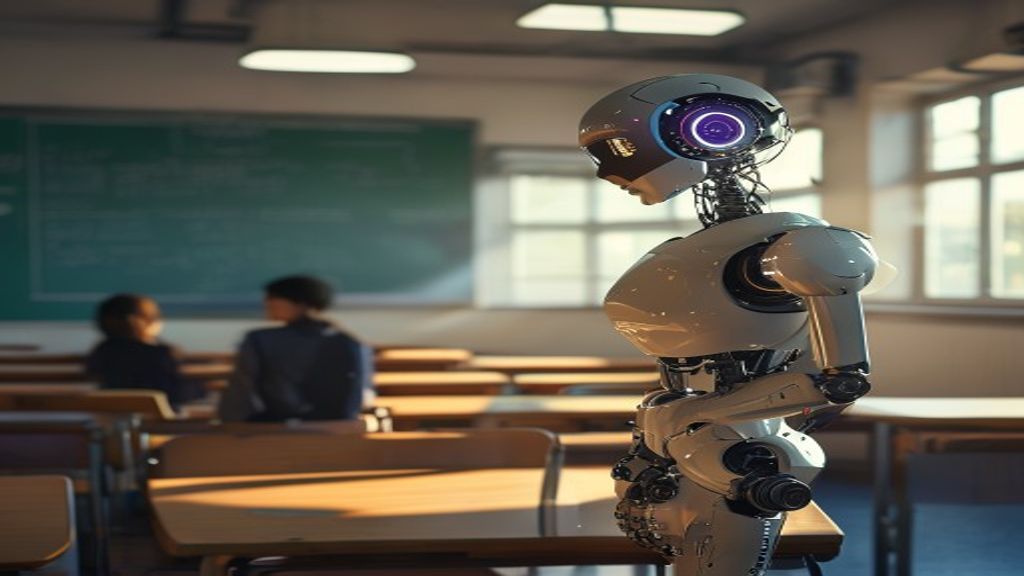
We can all agree that the modern classroom looks more like a NASA control center than the chalk-dusty rooms of our childhood. We were promised a revolution. For the last decade, Silicon Valley has whispered a seductive promise: that if we just get the right software, we can solve the "inefficiency" of the human mind. It sounds perfect, doesn't it? But here is the truth they won't tell you: replacing a teacher with an algorithm is like replacing a parent with a manual. In this article, we will explore why the grand experiment of education technology is faltering and why the hidden costs are being paid by our children’s developmental health.
Think about it.
When we treat learning like a data-processing task, we lose the very essence of what it means to be educated. We have traded wisdom for throughput. We have swapped inspiration for optimization. And the results are starting to show a deep, systemic crack in our pedagogical foundations.
The GPS Analogy: Navigation vs. Knowledge
To understand the failure of AI-driven instruction, we must look at how we navigate the world. Imagine you are driving through a new city. If you use a GPS, you will reach your destination perfectly. You didn't miss a turn. You didn't get lost. But if I take the phone away from you five minutes after you arrive, could you find your way back? Probably not.
You followed directions; you didn't learn the landscape.
This is exactly what digital learning platforms are doing to the student brain. When an algorithm guides a student through a math problem, providing "just-in-time" hints and correcting every micro-error instantly, it prevents the "productive struggle." The student reaches the "answer" (the destination), but they haven't built the mental map of the concept. They have become passengers in their own education, leaning on a digital crutch that atrophies their critical thinking skills.
But that’s not all.
The GPS doesn't care if you're tired, if you're curious about a side street, or if you're feeling overwhelmed by the traffic. It just recalculates. In the same way, automated grading systems and delivery platforms lack the "situational awareness" that a human educator possesses. They see a wrong answer as a data point, whereas a teacher sees it as a window into a child's misunderstanding.
The Disruption of Traditional Education Technology
There was a time when education technology meant tools that empowered teachers—overhead projectors, calculators, and basic word processors. These were force multipliers. They allowed the teacher to do more, but the teacher remained the "sage on the stage" or the "guide on the side."
However, the shift toward "disruptive" EdTech changed the goal. The objective became disintermediation—the fancy Silicon Valley word for cutting out the middleman. In this case, the middleman is the human being with a teaching degree. The venture capitalists funded platforms that promised to "democratize" learning by making it teacher-proof. If the software is good enough, they argued, the quality of the teacher doesn't matter.
They were wrong.
The screen-based pedagogy we see today often reduces the complex, social act of learning to a series of dopamine-triggered feedback loops. It’s "Gamification," but without the soul. Students aren't motivated by the beauty of the subject; they are motivated by the digital badge, the streak, or the leaderboard. This is extrinsic motivation on steroids, and it vanishes the moment the screen is turned off.
The Erosion of the Student-Teacher Bond
Ask any successful adult about their education. Do they mention a specific software update? Do they talk about a particularly sleek user interface? No. They talk about Mr. Henderson who believed in them when they failed. They talk about Mrs. Chen who noticed they were sad and stayed after class to talk.
The student-teacher bond is the "secret sauce" of human development. Neurobiology tells us that the brain learns best when it feels safe, seen, and socially connected. An algorithm cannot "see" a student. It can track their eye movements with a camera and measure their "time-on-task," but it cannot provide the emotional safety required for true intellectual risk-taking.
Look:
An algorithm can tell a student they are 80% proficient in long division. A teacher can tell a student, "I know this is hard for you, but I’ve seen how much you’ve grown, and I know you can do this." One is a measurement; the other is a transformation. By prioritizing personalized learning algorithms over human connection, we are creating a generation of students who are technically proficient but emotionally isolated.
The Personalized Learning Trap and Filter Bubbles
Silicon Valley loves the term "personalization." It sounds like a luxury service. In reality, in the context of education technology, it often means creating a "filter bubble" for the mind. If a student is struggling with a concept, the algorithm often simplifies the material or redirects them to "easier" paths.
While this prevents frustration in the short term, it creates a long-term problem. Real life is not personalized. The workplace is not personalized. Science is not personalized. By shielding students from the friction of difficult, non-intuitive ideas, we are failing to build their "intellectual grit."
Furthermore, these algorithms are often "black boxes." We don't know why a specific student is being fed a specific piece of content. We are outsourcing the curriculum to private corporations whose primary goal is "engagement" (keeping the kid on the screen) rather than "edification" (growing the kid’s mind).
It gets worse.
When every child is on their own "personalized path" via their own device, the classroom stops being a community. There is no more shared inquiry. There is no more heated debate about a poem or a historical event. The classroom becomes a room full of silos, each child staring at their own glowing rectangle, isolated in their own custom-tailored reality.
The Privacy Tax: Data as the New Tuition
We must talk about the cost that isn't measured in dollars. When we integrate digital learning platforms into every minute of the school day, we are subjecting children to the most intensive surveillance regime in human history. Every click, every hesitation, every misspelled word, and every "off-task" glance is recorded, processed, and stored.
This is the "Hidden Cost."
Our children’s cognitive profiles are being sold to the highest bidder under the guise of "improving learning outcomes." We are essentially using our students as unpaid beta-testers for AI companies. This data isn't just used to help them learn; it’s used to build "predictive models" of their future behavior. Is a child who struggles with focus in 3rd grade being flagged by an algorithm as a "low-potential" worker in 2040? We don't know, and that should terrify us.
Conclusion: Returning to the Human Heart of Schooling
We are at a crossroads. We can continue down the path of "automated education," where teachers are relegated to being high-priced babysitters for machines, or we can demand a pedagogical shift back toward humanity. Technology should be the pen, not the author. It should be the microscope, not the scientist.
The failed experiment of Silicon Valley has shown us that while software can transmit information, only a human can transmit inspiration. We must reinvest in the human element in teaching. We must reduce screen time and increase "talk time." We must recognize that a child is a flickering flame to be tended, not a vessel to be filled with data points via a USB-C cable.
In the end, the most important education technology ever invented isn't a new chip or an AI model—it is the direct, empathetic, and challenging conversation between a teacher and a student. Let’s make sure we don't code that out of existence. Our future depends not on the speed of our processors, but on the depth of our people.
Posting Komentar untuk "The Ghost in the Classroom: Silicon Valley's Failed Experiment"